The Tree of Life, Explained: A Beginner’s Map of Qabalah
A plain-language introduction to the Tree of Life, the ten Sephiroth, and how the Qabalah is actually studied — without the jargon.
The Tree of Life is a diagram — ten spheres joined by connecting paths — that maps how existence and consciousness are understood to unfold, from a divine source down to the physical world. Qabalah (also spelled Kabbalah or Cabala) is the mystical tradition that reads this map, using it to study the structure of reality and the inner architecture of a human being. Put simply, it is a framework for making sense of experience: a shared vocabulary for things that usually resist words. Because many lineages have shaped it over the centuries, the Tree is best treated as a living model to explore rather than a fixed doctrine to memorize.
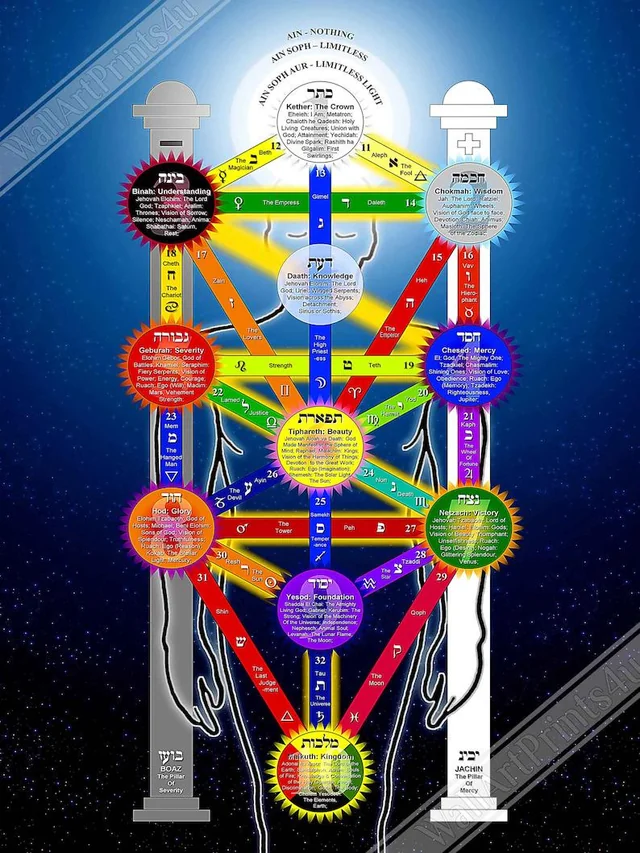
One Glyph, Many Readings
At first glance the figure can look like a puzzle: circles arranged in a particular pattern, laced together by lines. Each circle is a Sephirah — a station or quality of being — and each line is a path between them. The whole design is sometimes called the “32 paths of wisdom,” counting the ten spheres plus the twenty-two paths that connect them.
It helps to remember that the version pictured here is one common arrangement. Jewish, Hermetic, and Christian streams have each drawn and interpreted the Tree in their own way, so small differences between diagrams are normal rather than errors.
A Map of Consciousness, Not a Place
The Tree is often described as a map of consciousness. Instead of charting physical territory, it lays out levels of mind and being — from ordinary, embodied awareness toward increasingly subtle states. Read from the top down, it describes how the unmanifest becomes manifest; read from the bottom up, it traces a journey of return, from everyday awareness back toward the source. Neither direction is “the answer.” They are two ways of following the same structure.
The Ten Sephiroth, in Broad Strokes
Each of the ten Sephiroth stands for a distinct quality or stage, and only a couple need concern a beginner. At the crown of the Tree sits Kether, whose name means “Crown” — the point of unity and origin. At the base sits Malkuth, “Kingdom” — the realm of the body, the senses, and daily life. The eight spheres between these two describe the stages that link source and substance. Traditions attach detailed correspondences to each — colors, names, symbols — but you don’t need any of that to grasp the shape of the whole. Begin with the two poles, Kether above and Malkuth below, and let the middle fill in as you study.
The Three Pillars: Mercy, Severity, and Balance
Look again and you’ll notice the spheres fall into three vertical columns, known as the three pillars. The right-hand column is associated with expansion and is traditionally called the Pillar of Mercy; the left-hand column is associated with restraint and is called the Pillar of Severity. Running down the center is the Pillar of Balance, or Equilibrium, which reconciles the two. The lesson is intuitive before it is ever technical: a life, like the Tree, stays healthy when force and restraint are held in balance rather than either running unchecked.
What “Pathworking” Means
Reading about the Tree is one thing; travelling it is another. Pathworking is the experiential practice of moving, in imagination and focused awareness, along the paths between the Sephiroth — usually through guided meditation, visualization, or contemplation. Where study asks what a path means, pathworking asks what it feels like to walk it, treating the diagram as an inner landscape you can actually visit. It is a disciplined practice, best approached gradually and, ideally, with someone experienced to guide the way.
Studying the Tree vs. Practicing It
That points to an old and useful distinction. You can approach the Qabalah as a subject to study — its history, its Hebrew sources, its place in the wider story of religion and philosophy — and that scholarship is genuinely rewarding. You can also approach it as a practice to live: meditation, pathworking, ritual, and reflection that put the map to work in your own experience. The two are not rivals. Study keeps practice honest and grounded, while practice keeps study from drifting into pure abstraction. Most committed students eventually lean on both.
How to Begin
If the Tree intrigues you, start small and steady. Learn the basic vocabulary — Sephirah, path, pillar — and sit with the diagram until its shape feels familiar. Read a reputable introduction, and stay patient with the parts that don’t click yet. When you’re ready to go deeper, a structured guide matters, because this is a tradition that has always been handed on person to person. Our overview of the mysteries of the Tree is a natural next step, and for anyone drawn to a more formal, staged progression, the initiatory paths show how study and practice can unfold over time. Students work through this material in person at our temple room in Melbourne, Florida, where the map becomes something you explore rather than only read.
Key takeaways
- The Tree of Life is a diagram of ten Sephiroth joined by twenty-two paths — a symbolic map of how consciousness and reality unfold.
- Qabalah is the tradition that reads this map; Kether (“Crown”) sits at the top, Malkuth (“Kingdom”) at the base.
- Its three pillars balance expansion (Mercy) against restraint (Severity), with equilibrium down the center.
- “Pathworking” is the experiential side — meditative journeys along the paths, as opposed to reading about them.
- Study and practice complement each other; traditions vary, so keep an open, testing mind.
- You don’t need to be Jewish, religious, or experienced to begin.
Common Questions About Qabalah
Do I need to be Jewish or religious to study Qabalah?
No. While Kabbalah has deep roots in Jewish mysticism, the Hermetic or Western Qabalah taught here is studied by people of many backgrounds and beliefs, including those who consider themselves secular. What it asks for is curiosity, sincerity, and a willingness to reflect — not adherence to any particular faith.
Is Qabalah the same as Kabbalah?
They point to the same core tradition, and the different spellings are a rough convention rather than a strict rule. “Kabbalah” most often names the Jewish mystical tradition, “Qabalah” its Hermetic or Western esoteric adaptation, and “Cabala” Christian interpretations. Usage varies from author to author, so it’s worth noticing which stream a writer is working in rather than reading too much into the letters alone.
Do I need any experience to start?
None. The Tree of Life is a beginner-friendly entry point precisely because it gives you one clear image to build everything else around. You can begin with nothing more than an open mind — the vocabulary and the practices are introduced step by step.
Start With a Free 20-Minute Discovery Call
Curious whether Qabalah is your right next step? Talk it through with Dr. Bowen — where you are, what you’re seeking, and how this path fits your life. Free, relaxed, no commitment.

Transformative spiritual healing rooted in ancient teachings and modern practice. Guided by Dr. Duncan Bowen, PhD — Melbourne, Florida.
Contact
- 1600 Sarno Road, Suite 216
Melbourne, Florida - drduncanbowen@gmail.com
- (321) 543-8882